
Heat Lamp Wattage Calculator
A 10 sq ft brooder at 60°F needs about 120 watts of heat. This heat lamp wattage calculator works it out from your brooder floor area and the room temperature around it, using the planning figure of 10 watts per square foot at 70°F, plus 20% for every 10°F below that. Enter your numbers for a wattage and bulb size.
Heat Lamp Wattage Calculator
Planning estimate. Figures vary by breed, strain, climate and management — see the sources cited on this page.
Key facts
- 10 W per sq ft at a room temperature of 70°F (21°C) is the planning figure for brooder heat.
- +20% for every 10°F below 70°F. A room at 60°F needs 1.2× the watts of a room at 70°F; a room at 50°F needs 1.4×.
- Brooder temperature target: 95°F (35°C) in week 1, falling 5°F per week to 70°F by week 6.
- Fire safety matters more than wattage. The University of Minnesota Extension advises never hanging a heat lamp by its cord, using a lamp with a cage around the bulb, and keeping wires away from poultry, water and flammable litter.
- Figures are planning estimates from university extension sources. Where sources disagree, this page shows the range.
What watt heat lamp do chicks need?
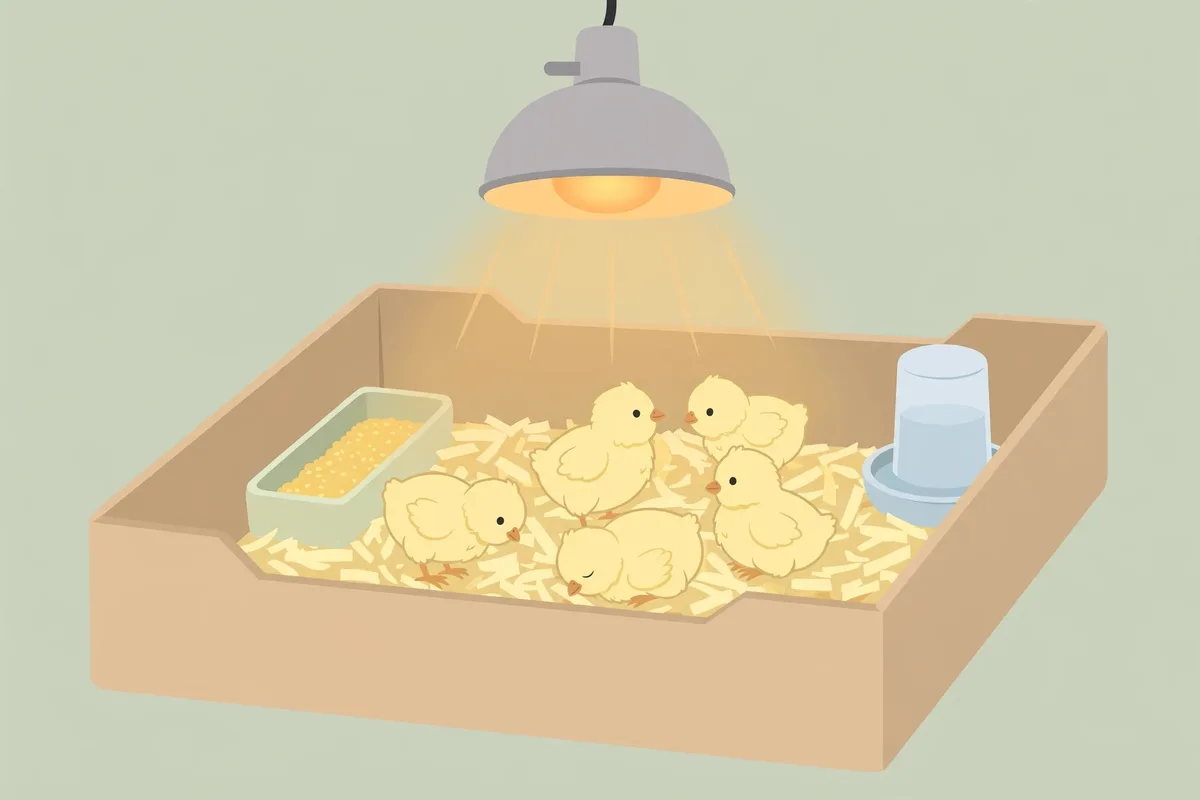
It depends on brooder size and room temperature, not on the number of chicks alone. A 10 sq ft brooder in a 60°F room needs about 120 W, so a 150 W bulb is the right size. The same brooder in a 70°F room needs only about 100 W. Measure the temperature at chick level, under the lamp and at the far end, and adjust from there.
How the heat lamp wattage formula works
The calculator multiplies brooder floor area by 10 W per sq ft, then adds 20% for every 10°F the room sits below 70°F. The 10 W per sq ft figure is the planning value used in the brooder guidance in the PeckCalc build figures, and the 20% uplift per 10°F is the same rule. It is a planning estimate: draughts, insulation and lamp height all change the real result.
How to use the result
Buy the next standard bulb size up from the calculated watts — 100 W, 150 W or 250 W — and hang it so chicks can move towards or away from the heat. Watch their behaviour: chicks huddled tight under the lamp are too cold, chicks spread out at the edges and panting are too hot. Use the brooder temperature calculator for the week-by-week temperature schedule, and the chick brooder size calculator to size the brooder itself.
What this calculator does not do
It does not replace a thermometer, and it does not account for insulation, draughts, lamp height or the number of chicks. A well-insulated brooder in a still room needs less heat than the same brooder in a draughty barn. It also says nothing about fire safety beyond the guidance above — secure every lamp with a clamp and a cage, and never rely on a single bulb for very young chicks.
Frequently asked questions
What watt heat lamp do chicks need?
It depends on brooder size and room temperature. A 10 sq ft brooder in a 60°F room needs about 120 W, so use a 150 W bulb. The same brooder in a 70°F room needs about 100 W. Enter your brooder area and room temperature in the calculator above for your exact figure.
How many watts of heat lamp do I need for my brooder?
Multiply your brooder floor area in square feet by 10 W, then add 20% for every 10°F the room is below 70°F. For example, a 5 sq ft brooder at 60°F needs about 60 W, and a 10 sq ft brooder at 50°F needs about 140 W, so a 150 W bulb.
How do I work out chick heat lamp wattage by brooder size?
Take the brooder floor area in square feet and multiply by 10 W per square foot at 70°F, adding 20% for every 10°F below 70°F. A 5 sq ft brooder needs about 50 W at 70°F and 60 W at 60°F; a 20 sq ft brooder needs about 200 W at 70°F and 240 W at 60°F.
Can I use a 250 W heat lamp bulb for chicks?
Yes, for a large brooder or a cold room — a 250 W bulb suits roughly 20 sq ft at 70°F or about 17 sq ft at 60°F. For a small brooder it is too much heat and chicks cannot escape it. Always hang the lamp so chicks can move away from the heat, and check the temperature at chick level.
Do chicks need a heat lamp at night?
Yes, for the first few weeks. Chicks need 95°F in week 1, falling 5°F a week to 70°F by week 6, day and night, until they are fully feathered at about 6 weeks. Use the brooder temperature calculator to work out the temperature for your chicks' age.
The How to Keep Chickens Warm in Winter guide covers this topic in more detail. Two related calculators worth checking next are the Chick Growth Calculator and Chick Feed Calculator by Age.